
The Story Of Holi
17 Mar 2014 1 Comment
in Uncategorized Tags: bhagavad geeta, Chap 4 verse 7, Faith, God will always be there, good over evil, Hiranyakashipu, Holi, Holika, Holika Dahan, Prahlad, pray, protect, pure, the story of Holi, victory, yada yada hi dharmasya
As we celebrate the joyous Holi with lots of laughter, colours, fun and frolic, it is truly important for us to know the story behind this auspicious day and why it is of utmost importance to us.
The Story of Holi by Ummeesh Kumar
A long time ago, there was a self centred king called Hiranyakashipu. Hiranyakashipu had done lots of penance and had been given many boons as a result of his penance. The boons were that he could not be killed inside or outside, during daytime or night time, nor on the ground or in the sky, not by any weapon and not by beast or human. Hiranyakashipu became very arrogant and He declared himself to be the God of the whole universe. He proclaimed that there was no other God but himself, and strictly said that Vishnu should have no worship offered to Him anywhere; instead everybody must only worship him.
Hiranyakashipu had a son called Prahlâd. Now, it so happened, that this Prahlad from his infancy was devoted to God. The monarch became very much enraged when he heard this and called the boy to his presence. He tried by gentle persuasions to dissuade Prahlada from the worship of Vishnu and taught him that he, the king, was the only God to worship. But it was of no use. The child declared, again and again, that Vishnu, Lord of the universe, was the only Being to be worshipped — for even he, the king, held his throne only so long as it pleased Vishnu. The rage of the king knew no bounds, and he ordered the boy to be immediately killed. He tried many ways to kill him such as throwing him off a mountain, poisoning him and many more but all those plans failed because Bhagawan always takes care of his devotees.
One day, Hiranyakashipu thought to himself: ‘I have tried SO many ways to kill him, but to no avail. What am I to do now?‘
His sister, the evil Holika came to his aid. She tells him, that she was given the boon that she will not burn in fire as long as she is wearing a special scarf. She suggested that she take Prahlad into a fire and he shall perish while she will remain unscathed. Hiranyakashipu thought this was a brilliant idea and they proceeded with their evil plan.
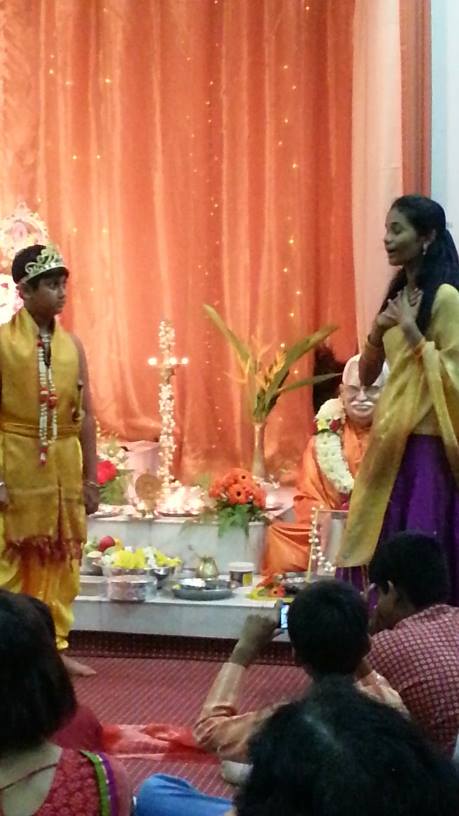
Holika plotting with Hiranyakashipu
Treacherously, Holika coaxed young Prahlad to walk with her and she herself took a walk into the blazing fire. Then, there was a sudden gust of wind and the scarf flew off Holika and landed on Prahlad’s arm. Holika then was burnt to death and Prahlad, who kept chanting the name of Lord Naarayana all this while, came out unharmed, as the Lord blessed him for his extreme devotion.

The burning of Holika
Thus, Holi derives its name from Holika and, is celebrated as a festival of victory of good over evil.
(During Holi, we walk around the fire and throw in black sesame into the fire to signify us throwing away our evil tendencies)
At this juncture, Hiranyakashipu was enraged and decided to take things into his own hands. He confronts his son Prahlad and shouts at him “Where is your God, Prahlad?”
To this, Prahlad sweetly replies “He is everywhere, father. He is in you, in me, in everybody.”
Hiranyakashipu enraged says “If he is everywhere, is he in this pillar?”
Prahlad bows and says “Of course he is, father”
And with that Hiranyakashipu destroyed the pillar with his sword and out jumped Narasimha. An avatar of Lord Vishnu.
Hiranyakashipu could not be killed by human, deva or animal, Narasimha is neither one of these, as he is a form of Vishnu incarnate as a part-human, part-animal. He comes upon Hiranyakashipu at twilight (when it is neither day nor night) on the threshold of a courtyard (neither indoors nor out), and puts the Hiranyakashipu on his lap (neither land nor sky). Using only his nails as weapons, he disembowels and kills the evil Hiranyakashipu.
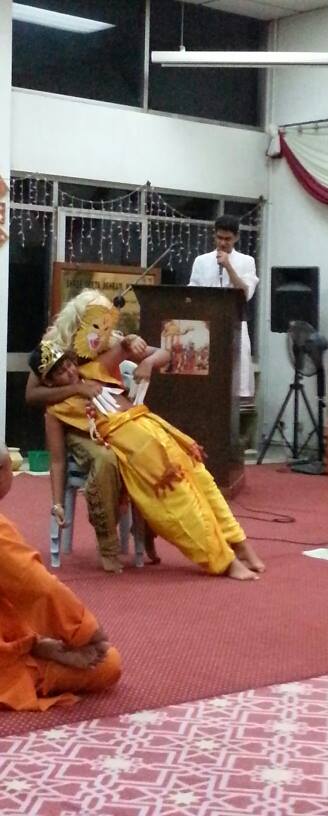
Narasimha kills Hiranyakashipu
Bhagawan says in Verse 7 of Chapter 4.
yada yada hi dharmasya
glanir bhavati bharata
abhyutanna madharmasya
tadatmanam usryjamhyamO Bharata, whenever there’s is a decline in righteousness and a rise in unrighteousness; then I manifest myself.
Jai Shree Krishna.
Jai Gurudev.
Bhagavad Geeta and Mahabharata Championships 2014
26 Jan 2014 Leave a comment

Jai Shree Krishna, Jai Gurudev.
The Geeta Ashram Youth are pleased to announce that we are organising a Bhagavad Geeta and Mahabharata Championships 2014!!! 🙂
It is our first event of the year and we hope to get children and youth together in the spirit of the Geeta.
For more information on the Championships, click here.
Misconceptions on Hinduism: Idol Worship
19 Jan 2014 1 Comment
in Uncategorized Tags: bhagavad geeta, Bhagavad Gita, Chapter 12, Devotion, Faith, geeta, Gita, hinduism, Hindus, Idol Worship, Idols, Misconceptions, Verse 5, worship
Many people scoff or are amused at the idea of idol-worship. Really, it’s not difficult to put yourself in their shoes and understand why they may react so sceptically to this thousand year old Hindu practice. Having grown in a multiracial country which hosts individuals of various faiths, I have met my fair share of sceptics or just simply curious individuals. Many a time, questions such as ‘Why do you worship idols made by human hands?’ or ‘Why do you pray to stone pieces?’ have been posed to me. Unfortunately for me, majority of these incidents occurred during my young schooling years. Back then, I didn’t have answers to supply and could either react by being ashamed or offended and storm off. Neither of which would benefit anyone.
I wish that I can proudly tell you today that I had reacted by going home with veins pounding full of determination to find an answer to the questions ringing in my ears, that I bombarded my parents with questions or that I played detective and did some sleuthing around, in other words conveniently googling the answer. I did no such thing and I’m not proud of how I dealt with the issue.
It was only years later that the answer came to me one Sunday morning. It was during one of the Geeta children classes I attended at the Ashram. I remember distinctly that we were reciting chapter 12 and how I attempted to multitask by reciting in Sanskrit and at the same time by reading the English translation inserted below. At one of the verses I remember stopping abruptly and inhaling a sharp gasp of air. It was somewhat an epiphany. Before me in one of the verses was an answer to the questions I had once avoided. Despite having recited the chapter innumerable times, I had never noticed that message before. I had a feeling similar to the one you have when you discover forgotten money in articles of clothing you haven’t worn in ages. It was a wonderful feeling and I’m overjoyed to inform you that even today the Bhagavad Geeta surprises me constantly with answers, sound advice or solutions when I least expect them. The verse that answered the questions I had about idol or deity worship was verse 5 from chapter 12 of the Bhagavad Geeta.
kleśo ‘dhikataras teshām
avyaktāsakta-cetasām
avyaktāhi gatir duhkham
dehavadbhir avāpyate
Severe is the path of those whose minds are set on the Unmanifest, for the goal of the Unmanifest is painful to reach by the embodied beings.
– Bhagavad Geeta Chap 12, Vs 5
In this verse, Bhagwan says that it is very difficult for an embodied being like you and me to worship him in his unmanifest form. The realized person, the sthitaprajna sees Divinity or God in every being, human or animal, the animate or the inanimate. But for ordinary people like you and me, it is easier to focus our thoughts and devotion on something visible, be it a stone, wood or clay. The shape and size of the statue does not matter. Even a picture if you look at it day after day with love and devotion, you will build an unseen bond with the object of your devotion and that regular Abhyasa (practice) will finally make you aware of The Divinity within you.With help from the verse above and other verses from the Bhagavad Geeta, I have been able to destroy the doubts I once harboured as well as fully understood the reason and meaning behind idol worship. Today, I have decided to illuminate those who have yet to discover the answers to the many questions regarding idol worship. Hopefully by the end of this article I would have dispelled any ignorance and replace your doubts with answers.
Below are a few insights explaining idol worship:
- Easiest way to install faith and devotion
To intellectuals who are well informed in spiritual knowledge, the abstract concept of God may be engaging, but to an ordinary individual the idea is complex and difficult to comprehend. On the other hand, an ordinary individual like you and me will find a concrete image or idea of God that we can easily grasp far more appealing. For example the image of Ganesha or the idea of Krishna we hear from many stories. An idol will represent God and his many qualities thus making it easier for us to believe in His existence and to devote ourselves to Him rather than attempting to worship the unmanifest or the formless. - A way of acknowledging the omnipresence of God
From a sub-atomic particle to the great stars, God is manifested in all His creations.
We believe that God is ‘Omnipresent’. If God is everywhere, then surely He is in that idol. In idol worship, a devotee gives as much love and respect to his/her idol believing that God resides in it. - Idol worship helps devotees to become deeply religious
Once an idol is installed in the house or in a puja mandir (place of worship in a house), the very house becomes a place of God’s residence, a very sacred place, a temple by itself. The idol reminds household members of the divine presence and of their religious duties and responsibilities. It inspires devout men to keep their houses pure and not to indulge in sacrilegious acts. - Aid to concentration
More than any abstract concept, an image or a symbol is the best aid to concentrate and control one’s mind and attention. By focusing the mind on an image, the mind can be tamed and stabilized. Today science has been able to proof that images subdued in the subconscious plays a significant role in shaping one’s life and destiny. The ancient Hindus were aware of the potentiality of the mind and therefore did not object to the worship of idols. They knew it was the best way to lead the fickle human mind towards God. - An effective prayer : Communicating with God.
Idol worship helps us to focus the energies from our prayer into a strong current flowing in one particular direction. Besides, the supposed physical proximity to God intensifies the emotional fervour and charges the prayer with love and devotion.
There are many reasons why a devout Hindu worships idols. To simply explain it, idol worship is the best method of communication with God for many Hindus.
Religion is a matter of faith. There is no one right way to attain God. The paths to God are many and many are the ways one can reach Him.
Hari Om.
This truly insightful article has been written by Nayantara Soni, 19 years
A Lesson in Faith
09 Jan 2014 Leave a comment
in Uncategorized Tags: bhagavad geeta, Ch 9 Vs 3, Chapter 9, Faith, Ganga, Ganges, Gita, Lord Shiva, Parvati, River, sinless, Sins, sins washed away, Verse 3
It is said that one who has taken a dip in the Holy Ganges is free from all sin and will attain the Lord. Thousands of devotees visit the Ganges yearly, yet many feel no different after taking a bath. Why is that so?
The answer to that question is Faith.
One Day, Parvati Mata asks Lord Shiva, “Dear husband, if every devotee who takes a bath in River Ganga will join us here in the heavens, will there be enough room for everyone?”
Lord Shiva smiles and says, “Dear Parvati, you shouldn’t worry about that and let me show you why. Let us go down to Earth, to River Ganga. I will take the form of a very ill, poor elderly man who is nearing his end. I will be lying by the river bank, unable to move stricken with disease. The only way to end my suffering is to have a few drops of Ganga Jal given to me by a sinless man. I would like you, O’Parvati to find someone there who can give me these few drops of Ganga Jal.”
Parvati Mata agrees to carry out Lord Shiva’s plans. So, they go down to Earth and Lord Shiva takes the form of an ill man.
Parvati Mata first approaches a young man who has just come out after taking a dip in the ganges. She says “Dear sir, could you please help me? My husband is very ill and he needs just a few drops of water from River Ganga from a sinless man. Can you help me?”
The young man replies, “Oh lady, i’m very sorry but i have committed many, many sins in my life. I won’t be of any use to you or your husband!” He then walks away.
Parvati Mata then approaches another person who has just taken a bath in the Ganges for help. Once again she gets the reply, “Oh i’m sorry, mam – but i have performed countless sins in my lifetime!”
And so this goes on for hours as everyone Parvati Mata approached gave the same answer. Parvati Mata asks many people as they come out of the river after taking their bath, but to no avail.
Finally, she stops an old gentleman and asks “Dear sir, could you please help my husband? He is extremely ill and is in dire need of a few drops of Ganga Jal from a person who has committed no sin.”
The gentleman replies, “Oh dear lady, I can help you!! I have just taken a dip in the Ganges and therefore I am clear of all sins. I will help you!”
He then goes to the river and takes the Ganga Jal and pours it on the elderly man.
Immediately, Lord Shiva takes his true form, blesses the man and liberates him. He then tells Parvati Mata “Of all the people you have approached today, He was the ONLY one who believes and has faith that his sins will be washed away in the Ganges. Everyone else just performed it as a ritual with no true faith. That is why, my dear you needn’t worry at all about space in the heavens ;)”
aśraddadhānāḥ puruṣā
dharmasyāsya parantapa
aprāpyamāḿnivartante
mṛtyu-saḿsāra-vartmani
O Arjuna, people devoid of faith in this Dharma (way), do not attain Me, but return to the path of the mortal world.
– Bhagavad Geeta Chapter 9, Verse 3
Hello 2014 :D
02 Jan 2014 Leave a comment
in Uncategorized Tags: 2014, bhagavad geeta, inspiration, liberate, Lord, new, New Year, positivity, strength
Alas, we say goodbye to 2013 to welcome an incredible 2014 – a new year and a chance for a fresh, new beginning. As we celebrate the dawn of this New Year, the Geeta Ashram Youth would like to extend our warmest wishes to you all. 2013 has hosted some wonderful moments for the Ashram – the annual Janmashtmi celebrations, the Geeta Ashram Art Competition, our Radha Krishna Bhajan Yatra, weekly Geeta classes and the list goes on.
Time is indeed of the essence, so let us not waste any of it. Let’s embrace a 2014 where time is spent on philanthropy & reflection, identifying the peaks & troughs of our days and internalizing lessons learnt. Let’s liberate ourselves from the unnecessary concerns and fears that bind us down and allow the Lord to guide us as we negotiate life’s crevices.
Let’s live a life with Bhagawan and for Bhagawan.
We’ve got 365 days left to change our world for the better this year. Let’s go!
Geeta Jayanti Celebrations
13 Dec 2013 Leave a comment
in Uncategorized Tags: auspicious, bhagavad geeta, celebrations, geeta, geeta ashram malaysia, Geeta Jayanti

Geeta Jayanti celebrated today with a beautiful full Geeta Havan at the ashram!
Shubh Geeta Jayanti to all from the youth!
Jai Shree Krishna!
Sacred Thought – December issue out!
12 Dec 2013 Leave a comment
in Uncategorized Tags: bhagavad geeta, Bhagavad Gita, e magazine, geeta ashram, Geeta Jayanti, hinduism, Magazine, Sacred Thought, spirituality
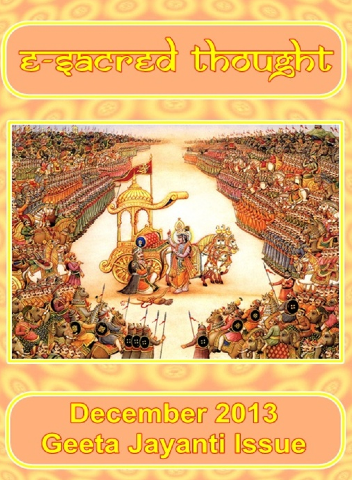
Sacred Thought – Dec 2013
Do check out the Geeta Jayanti issue of Sacred Thought right here!
This month’s issue is filled with many interesting articles and interactive activities – one is sure to be spiritually enlightened! Enjoy!
Our Condolences.
06 Dec 2013 Leave a comment
in Uncategorized Tags: bhagavad geeta, Bhagavad Gita, Chapter 3, JSK, loss, Madiba, Nelson Mandela, president
For whatever a great man does, the same is done by others as well; whatever standard he sets, people follow.
– Bhagavad Geeta Chapter 3, Verse 21

A tribute to a man who worked so hard for the betterment of millions of people. May God Bless Your Soul. JSK.
Website Launch! :D :D :D
04 Dec 2013 4 Comments
in Uncategorized Tags: bhagavad geeta, geeta ashram, Geeta Ashram Youth, Guruma
Our Dearest Guruma Geeteshwariji is down in Malaysia for the Geeta Jayanti Celebrations and she officially launched our website today! 🙂
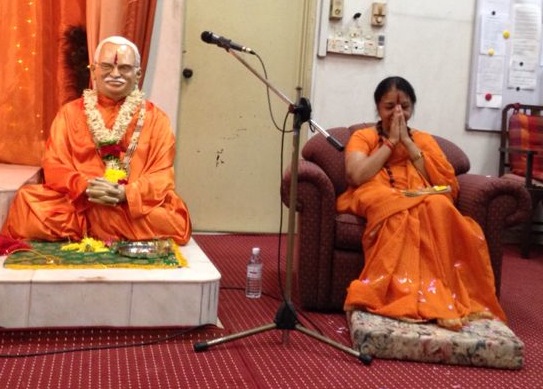
Jai Shree Krishna! Jai Gurudev!


 Geeta Ashram Youth