HOLI and Maharaji’s 116th Birthday Celebrations!

holi

Join us in celebrating HOLI and Swami Hari Harji’s 116th Birthday! 🙂

Swami Hari Harji

Our programme tomorrow is as follows:

Morning:
9.30 am to 1 pm –  Full Bhagavad Geeta Havan

Evening:
7.00p.m.     Bhajans
7.30p.m.     Lighting of Holi fire / circumambulation
7.45p.m.     Guru Vandana, Recitation of Chapter 12 with samput verse, Geeta Aarti
8.00p.m.    Personalized Guru Pooja, obeisance & offering* with simultaneous bhajans / chanting
                    Children’s Programme  (Diya offering to Swamiji, Bhajan Singing and a short skit on Holi)
8.45p.m     Announcements / Final Aarti
9.00p.m.    Preeti Bhojan

 * A traditional, humble token / love offering from a grateful shishya (student) for the precious gift of having a Guru’s presence & blessings in his life. Contributions are channeled towards the Guru’s cause.

Our children are all geared up for tomorrow’s event! 🙂 

Look forward to everyone joining us in the celebrations! 🙂

Jai Shree Krishna. 
Jai Gurudev. 

Let us Unite in Prayer.

kaunteya pratijanihi na me bhaktah pranasyati

Know that, for certain, my devotee never perishes
Bhagavad Geeta: Chapter 9, Verse 31

our thoughts and prayers are with the crew, passengers and all their loved ones of flight MH 370.

Smile.. and brighten your day! :)

Smile.. and brighten your day!

Har Haal Mein Kushi! 🙂
Smile Always! 🙂

Image

Let the Countdown Begin!

Imageonly ONE month to go before the Bhagavad Geeta and Mahabharata Championships 2014!!! 😀 😀 😀

With more than 100 participants registered, we are truly looking forward to a fun-filled and exciting day! 🙂


Shubh Maha Shivratri

Image

Lord Shiva drinking the poison

Shivratri, also known as “The great night of Lord Shiva”, is the most important festival for the millions of disciples of Lord Shiva. Celebrated on a moonless February night, Shivaratri falls on the 13th or the 14th night of the new moon during Krishna Paksha (dark fortnight) in the Hindu month of Phalgun (corresponds to the period between the months of February to March).

According to Hindu mythology, during the Churning of the Ocean of Milk known as “Samudra Manthan”, a very lethal and toxic poison, also known as the “Halahal”, had emerged from the ocean. It is believed that this poison was so toxic that even thinking about it could have caused a state of unconsciousness! It is then believed that Lord Shiva immediately arrived at the sight, took the poison from the ocean and in an act to protect the universe, drank the poison. But before swallowing it, Goddess Parvati pressed her hands on Lord Shiva’s throat. The poison was held at the base of Shiva’s throat which caused his entire throat to turn blue in colour. Since then, Lord Shiva came to be known as  “Nilkantha”, the blue-throated one. Every year, Shivratri celebrates this event by which Lord Shiva saved the world.

To worship Lord Shiva on Shivaratri is deemed to be extremely auspicious and a devotee who performs sincere worship of Lord Shiva on a Shivratri is to be absolved of sins and attains moksha (liberation).

SHUBH SHIVRATRI! 🙂 
Om Namah Shivaya!

Tamaso Maa Jyotir Gamaya

Tamaso Maa Jyotir Gamaya

Image

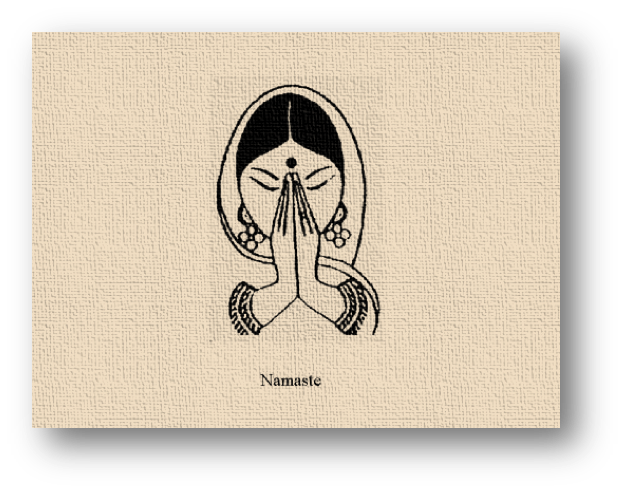
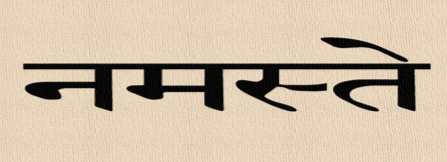
The Meaning of Namaste

Image

What does Namaste mean? Is it just a customary greeting one says to another?  Does it translate to mean ‘Hello’ in Hindi?

Many of us would describe the word Namaste as a way of saying ‘Hello’ or acknowledging another individual. Little do we know that this simple word has an extremely profound spiritual meaning behind it and is not just a superficial greeting.

When somebody says Namaste, what the person is really saying is, ‘I bow to the divinity in you which is the divinity in me’ or to phrase it differently, ‘The divine in me honours the divine in you.

Literal translation from Sanskrit to English:  I bow to you.

  • Nama  –  bow
  • As        –  me
  • Te        –  you

The gesture or greeting firmly expresses the belief that there is a divine spark within all of us. Saying Namaste is recognising that we all share a common divinity and are therefore equal.

Now, what is the right way to perform Namaste? Firstly place your hands together at the heart. Now close the eyes and bow the head slightly. Your hands can also be placed in front of the area between the eyes also known as the third eye.

Although Namaste is usually said simultaneously with the gesture, the gesture alone carries the same meaning as the word and can therefore be performed without uttering the word.

The union of one’s palm is highly symbolic. The right hand represents the divinity within or the higher self. In contrast, the left hand represents the lower and worldly self. By joining the hands together, these two aspects are merged and is a pursuit to unify with the person in front. The bowing of head indicates deep respect or love.

There is more than meets the eye with this simple greeting. In a nutshell, it helps us recognise and honour God in all beings, accept equality amongst individuals and extend love, respect and peace to each other. We are one! 

Image

I honour the place in you in which the entire Universe dwells, I honour the place in you which is of Love, of Integrity, of Wisdom and of Peace. When you are in that place in you, and I am in that place in me, we are One.”
An Equal Eye

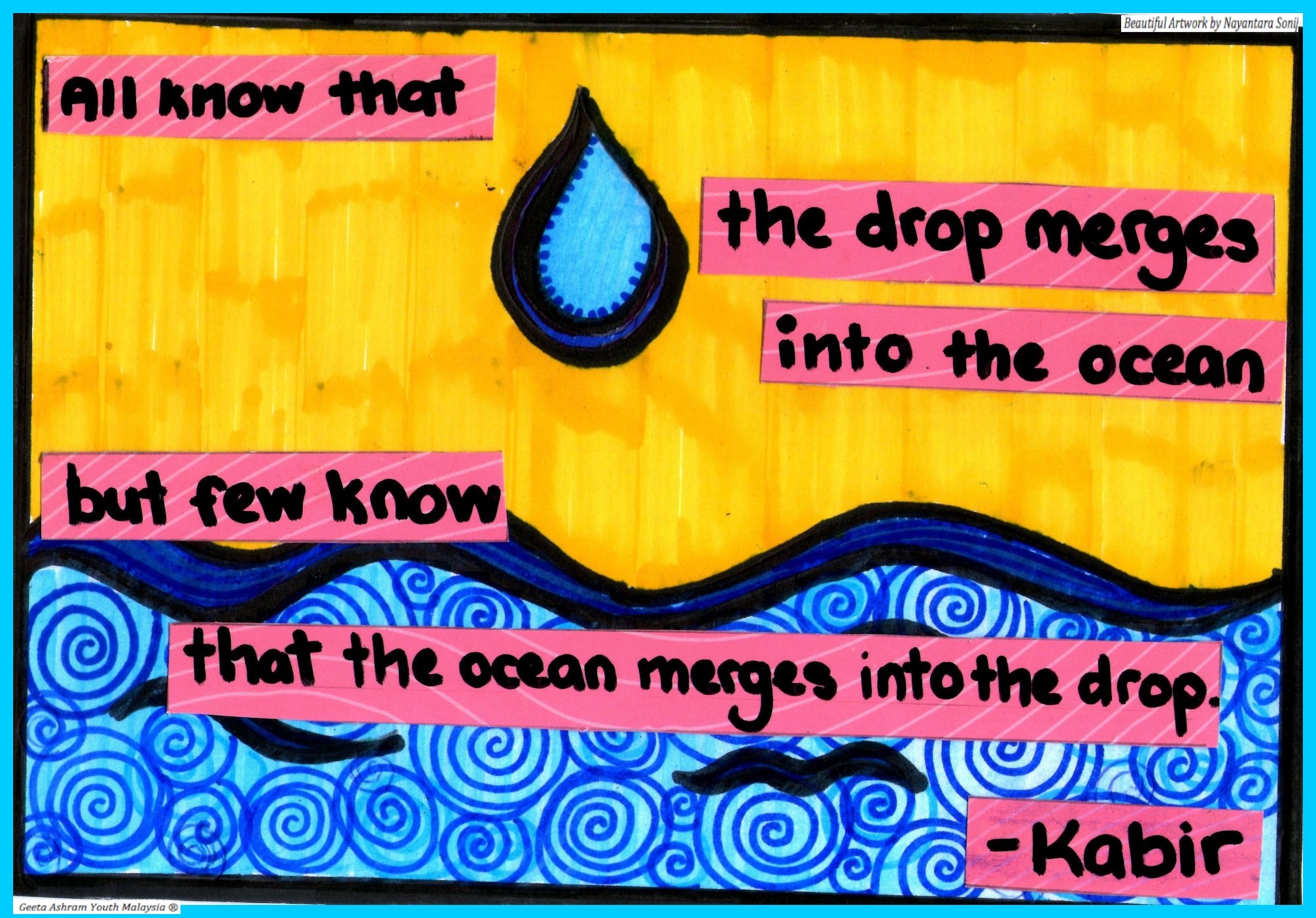
Kabir Quote
sarva-bhūtastham ātmānaḿ
sarva-bhūtāni cātmani
īkṣate yoga-yuktātmā
sarvatra sama-darśanaḥ

The Yogi, who is united in identity with the all-pervading, infinite, consciousness, and looks on all with an equal eye, sees the Self present in all beings, and all beings existing in the Self.

Bhagavad Geeta Chapter 6, Verse 29

Vasudevam Sarvam Iti

Image

Lord Rama’s Bridge

You may recall from your reading of the Ramayana that Lord Rama had to rescue Mother Sita from the demon king Ravana who was holding her captive in Lanka (aka Sri Lanka), an island south of India. Hanumanji, Lord Rama’s comrade, with his army of monkey-men built a “bridge,” or causeway, across the narrow strait from India to Sri Lanka to reach the island, in order to save Sita. There, a great battle took place before Lord Rama and Hanuman defeated Ravana and liberated Sita. This occurrence was said to have ensued in Tretha Yuga, which was more than 1.7 million years ago.

Only recently has NASA revealed a mysterious ancient bridge in the Palk Strait between India and Sri Lanka; another opening to the spiritual gates of people all around the world who have come to know an ancient history linked to the Indian mythology.

Today Rama’s Bridge or Rama Setu can be seen from the sky while traveling by air. This ancient bridge is submerged under water, but the satellite images give the perfect view of this bridge of mythological significance.

Let this be a reminder to all of us to appreciate another one of Bhagwan’s beautiful manifestations!

ImageImage

Image

Fun Fact!

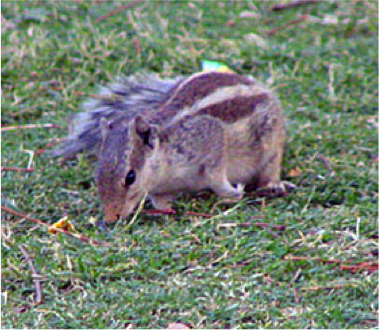
You may be wondering why there is a picture of this cute, little squirrel. Well, according to tradition, the squirrel helped build the causeway by rolling sand grains down to the water.  Therefore, as a sign of gratitude, Rama is said to have stroked the back of the squirrel which is why all Indian squirrels have the three dark lines on their backs from where the three fingers of Rama touched them.

This lovely article has been researched and put together  by Dayana Bulchand

Previous Older Entries Next Newer Entries