Here is the audio clip from our lesson last week! 🙂
For those who would like to re-cap or listen from Lesson 1, or if you have any trouble assessing the audio clip from this post – you may also click here! 😀 JSK!
The Geeta Ashram Youth would like to wish each and everyone of you a Happy Dushera and a Happy Navratri 🙂
We would like to share with you the lessons we learned during these last nine auspicious days!
Five things I learned about Navratri
By Vilsasha Belani
Navratri has just ended and with it, the nine nights of dancing the garba and dhandhiya raas, but I realised that there wasn’t a lot I knew about navratri beyond the “1, 2, 3, 4…” count of the dhandiya raas. So I did what any girl in this amazing age of technology does – I Googled it. So here are 5 new things I learned about navratri:
There are nine forms of Shakti that are worshipped When I was little, I was always told that the first three days of Navratri are for the Goddess Durga, the next three days are for the Goddess Lakshmi and the last three for the Goddess Saraswati. But that really is just the simplified version. The Navdurgas, as they are called, in order are Shailaputri (Daughter of the Mountains) or Parvati, Brahmacharini, Chandragupta, Kushmanda, Skandamata, Katyayani, Kaalratri, Mahagauri and lastly, Siddidaatri.
There is a reason behind the cocentric cirlces of the Garba. No, it’s not so there’s more space for the women and girls to dance. The co-centric circles are actually representative of the circle of life. Birth, death and rebirth is a continuous cycle we all must go through, but at the centre of the circle, unmoving and unchanging is the Goddess herself.
The dandiya dance is actually a dramatization of a battle. The bamboo sticks or dandiya represent the mighty swords of the Goddess Durga during her battle with Mahishasura. The swishing and striking of the dandiyas together is a reenactment of the Goddess weilding her swords during the battle and bringing the evil king to an end.
The Dandiya dance is not limited to only bamboo sticks The Mehr sect in India perform a type of Dandiya dance with swords and shields instead of the traditional bamboo sticks. The Mehr raas resembles strikes in a battle. Watch the video below for a performance done in the Royal Albert Hall: http://www.youtube.com/watch?v=sUaMdVKJVqc
There is more to Navratri than it being just a celebration of the Goddess Durga Like many Hindu festivals, there is a strong social aspect attached to Navratri. It is a festival that brings together communities, old friends and family in this rushed, hulla-baloo of a world. It is one of the times where children can’t wait to go to temple and in between the twirling sticks and clapping, they learn and understand more of their culture and religion. There is no doubt that the spiritual side of this festival is very important, but one can’t disregard the joy of seeing friends, the exhilaration from the beat of the music and silent unity of goodwill as we pray for good in us to trump the bad.
Last Thursday (18.09.2014), we started off with Chapter 1 and covered Verses 1 – 19.
Here is the audio clip from last week’s class!
As Uncle Ashok mentioned at the very end, Verse 20 is the turning point of the Mahabharat – we do look forward to having all of you join us for class next Thursday! 🙂
For the audio clip from the previous lesson, click here.
” I call upon you all to dedicate yourselves to the service of the new Malaya: to work and strive with hand and brain to create a new nation, inspired by the ideals of justice and liberty – a beacon of light in a disturbed and distracted world.”
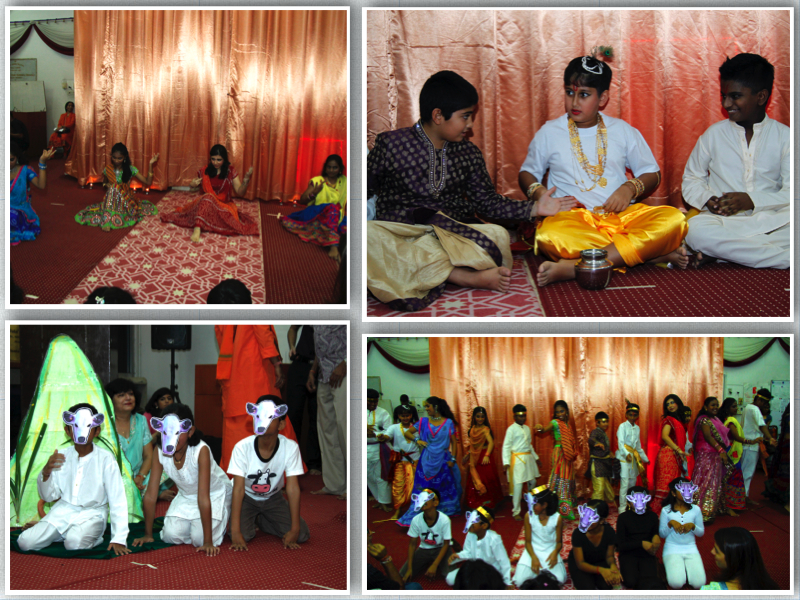
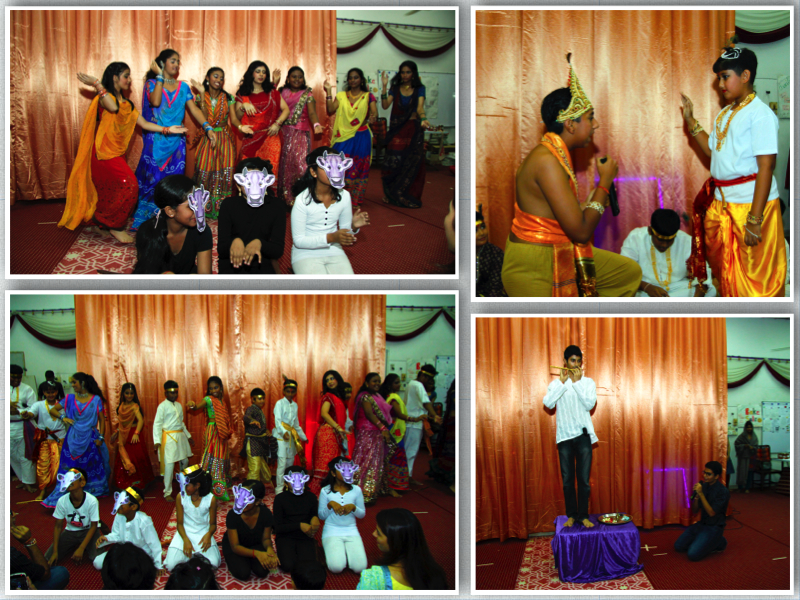
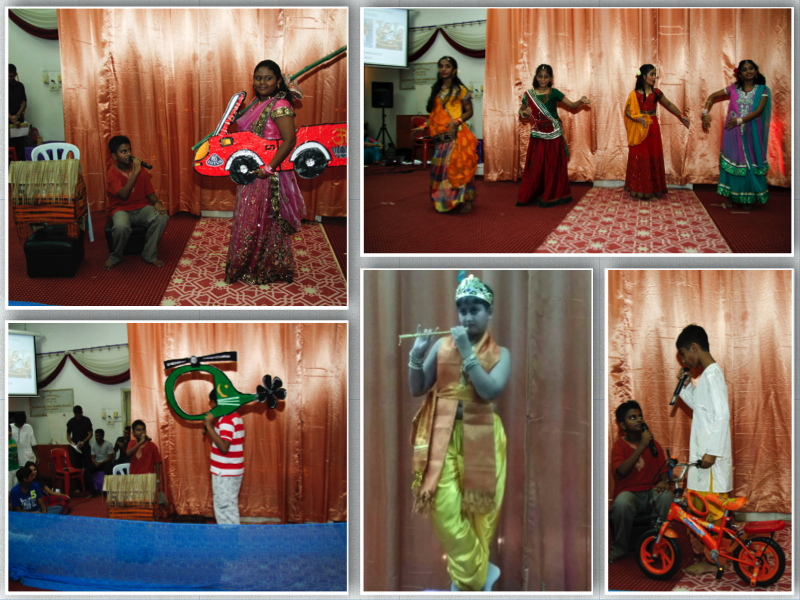
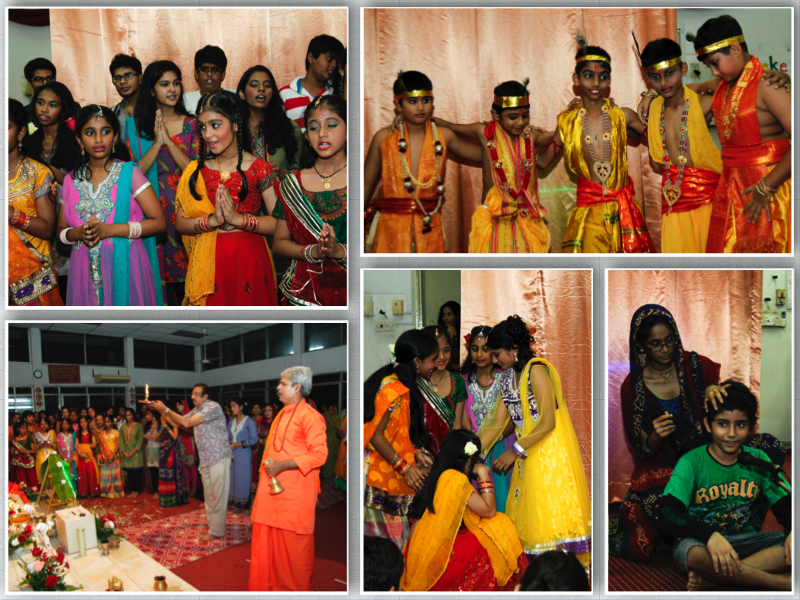
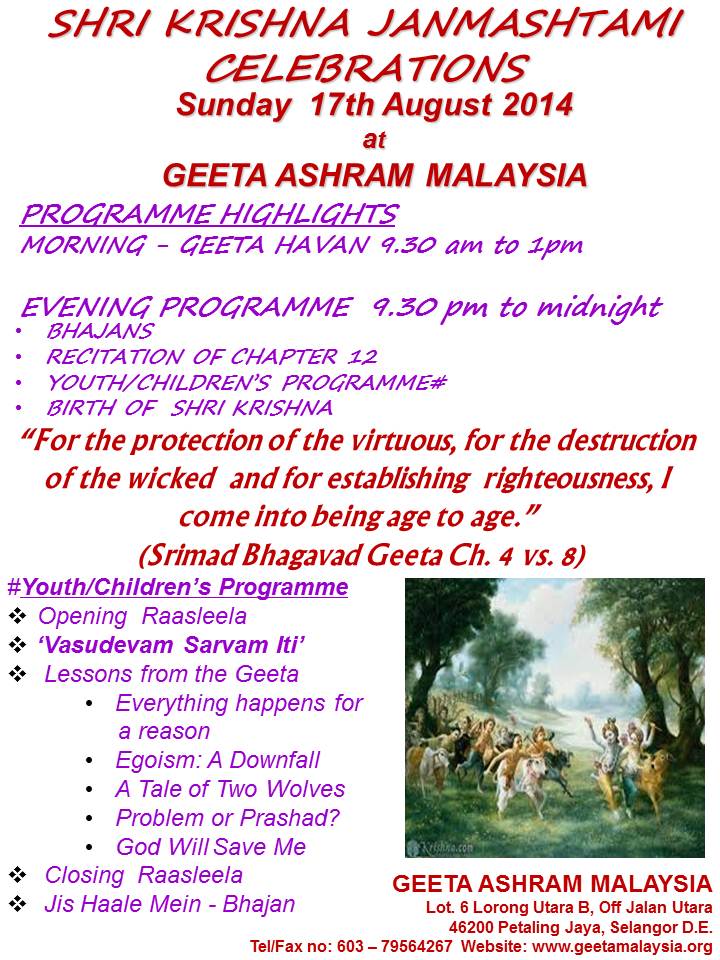
The Geeta Ashram Youth would like to wish everyone a very, very HappyJanmashtmi! 🙂 May God Bless Each and Everyone of you and may you all have a wonderful year ahead!
JSK!
We truly had a wonderful celebration at GA today (updates will be posted soon! ;)) Thank you to all who joined us!
There’s no other love like the love for a brother. There’s no other love like the love from a brother.
– Terri Guillemets
Historically, Raksha Bandhan is an ancient concept where queens used to send rakhis to their neighbourhood brothers as a sign of love and token of brotherhood. However, with most traditions, the entire concept of it has changed over time. Raksha Bandhan in Sanskrit literally means “the tie or knot of protection“. It is an ancient Hindu festival that ritually celebrates the love and duty between brothers and their sisters. The sister performs a Rakhi ceremony, then prays to express her love and her wish for the well being of her brother; in return, the brother ritually pledges to protect and take care of his sister under all circumstances. The festival is also an occasion to celebrate brother-sister like family ties between cousins or distant family members, sometimes between biologically unrelated men and women.
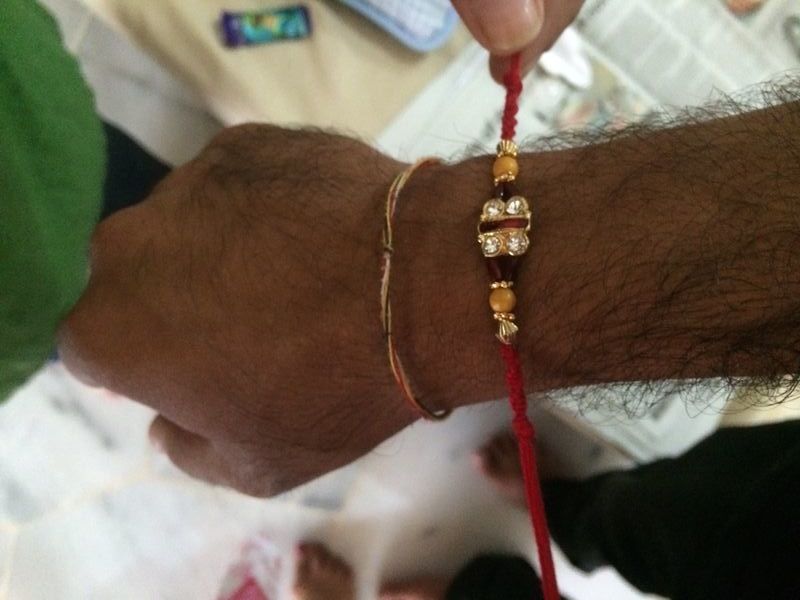
Having my Rakhi tied!
As with most Hindu festivals, there are a number of rituals that are usually carried out during this auspicious day. The sisters will usually shop for rakhis or even make their own out of colourful thread sometimes adorned with decorations or amulets. Meanwhile, the brothers will buy gifts for their sisters. On the day itself, the sisters will tie the rakhis on their brother’s wrist, followed by a simple prayer for the brother’s prosperity, good health and happiness and an aarti. Then, the sisters will feed their brothers sweets with their hands. In return, the brothers will then gift their sisters with the aforementioned gifts, and of course hugs are given and received left, right and center.
Personally, having grown up with three elder sisters and a number of cousins whom I regard as my sisters, I’ve always looked forward to this day. It’s a simple reminder to me that I am appreciated and I truly feel it does strengthen the bond between a brother and a sister. Only downside I could possibly think of is that my wallet is significantly lighter at the end of the day! 😉
The Geeta Ashram Youth would like to wish A very Happy Raksha Bandhan to one and all!





 Geeta Ashram Youth