01.04.2017 : 7 hours to go! :)

Jai Shree Krishna. Jai Gurudev.

It’s been such a wonderful week, and we can’t believe the finale is just 7 hours away!!

Please join us on our final day of the Praan Pratishta at 8am!

We will start with a Havan at 8am and the final installation of our deities will be conducted in all its granduer at 10am followed by an abhisegam of all the murtis. The program will conclude at 2pm.

To all devotees who wish to place the Paanch Datu (Five Precious Metals) beneath the deities, please note that “No Coins” will be allowed to be placed beneath the murtis.

Our sneak preview as promised!                                    – Lord Krishna’s beautiful lotus feet ❤

In the service of Guru, Geeta and Gopal;

Geeta Ashram Youth.
31.03.2017: Day 4 Praan Pratishta

So fast, and it was already day 4 today! 🙂

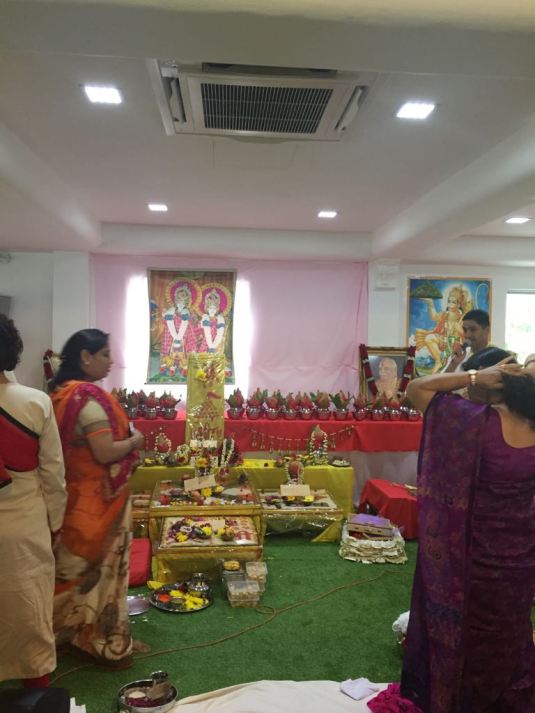
The temporary altar where all the prayers are being performed

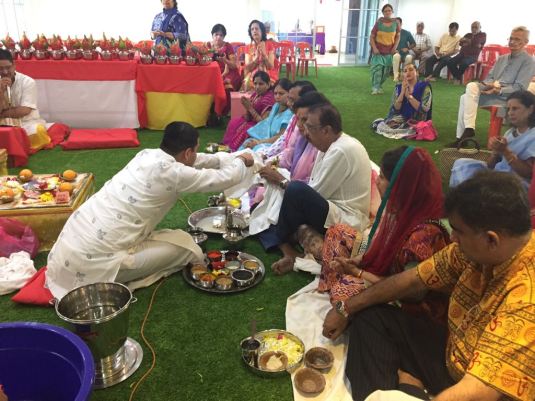
Today we performed a fruit and ghee abhishegam on our miniature moorthis –

Ghee Abhishegam


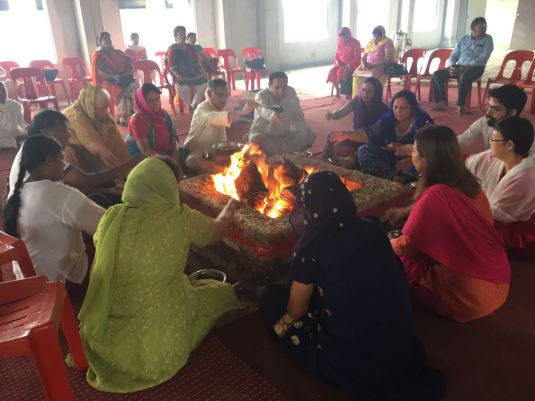
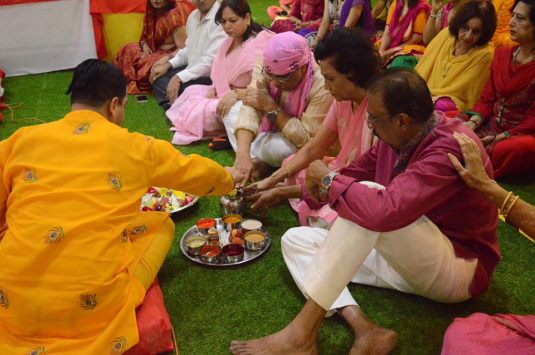
This was followed by a havan:

Devotees performing Havan today

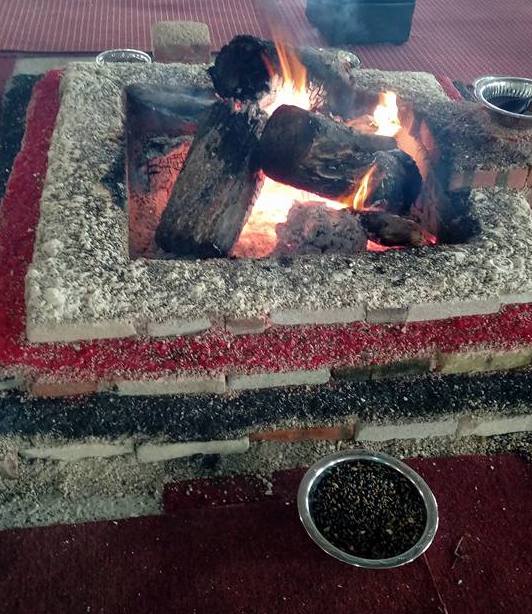
Did you know that the fire of this havan kund has been burning continuously from day 1? It will burn until the end of the ceremony tomorrow!

Tomorrow is THE day that we have been all waiting for – our moorthis being installed!!! Look forward to having all of you with us!

Look out for our next post which has a sneak preview 😉

30.03.2017: Day 3 Praan Pratishta

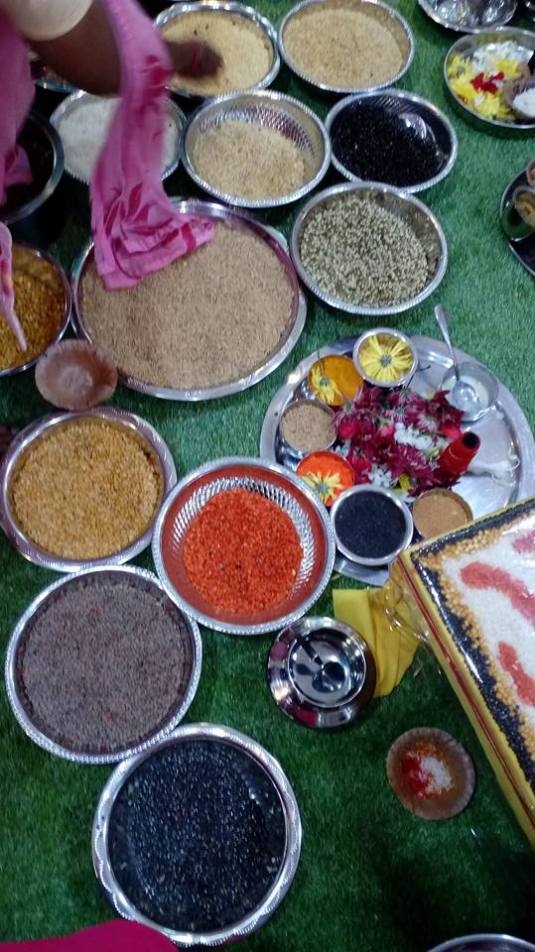
Grains are essential for the sustenance of human life. They represent prosperity and providence.

Today our Praan Pratishta ceremony kicked off with the Abhishegam of our miniature moortis with grains.

Pandatji preparing the grains needed for the Abhishegam


More than 20 different types of grains were used

Devotees then gathered for a Havan:

Havan 30.03.2017

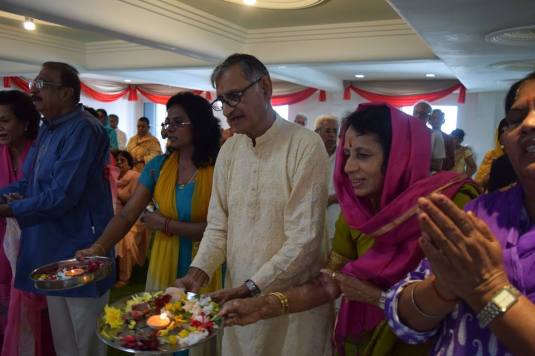
Aarti

It was such a lovely day!

2 more days till we get to see our moorthis! 😉 Look forward to having all of you there with us!

29.03.2017: Day 2 Praan Pratishta

Our moorthis were brought out today!!!! 🙂 🙂 🙂 Buttttttt… they are currently covered in cloth and we are still unable to see them as yet… Our revered Pandatjis and Acharyaji who have come from India for this auspicious ceremony explained to us the steps of the Praan Pratishta, and it won’t be till the end of the week till the Praan
is placed into the moorthis, and they are placed at the altar.

The morning started with prayers, followed by the Abhishegam of Baby Krishna.

Abhisegam of Baby Krishna


After that, we had the Abhishegam of the miniature versions of our moorthis – and everyone who was present was blessed to be able to perform the Abhishegam

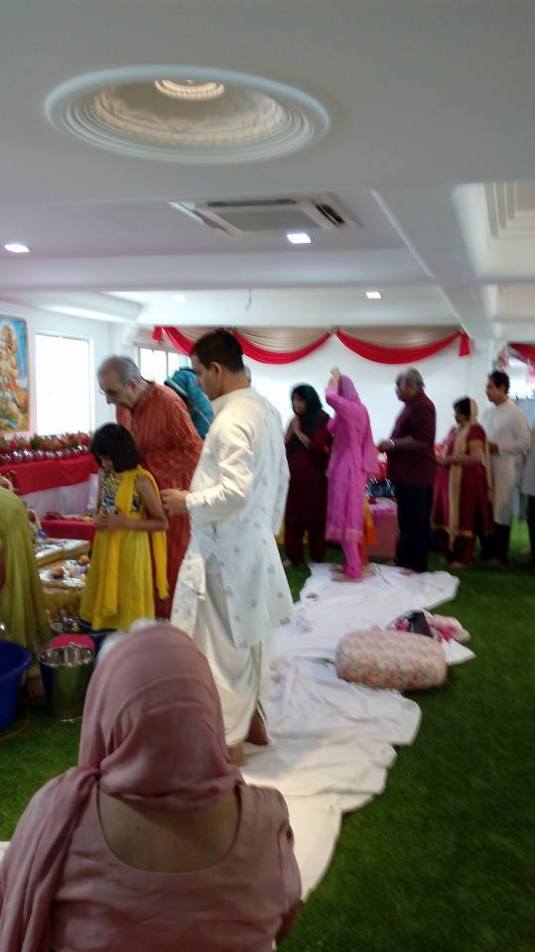
Devotees lining up to perform the abhishegam


Devotees lining up to perform the Abhishegam

We also dedicated a prayer session to our pandatji – Mr. Satyavan Mishraji who has dedicated the last 12 years of his life to Geeta Ashram Malaysia, whose wherabouts, we wish so much, Bhagawan would let us know. We are still actively searching, and praying for his safe return ❤

The morning’s events culminated with a Havan where we recited Chapter 12 and 15 of the Bhagavad Geeta, along with other verses.

Havan

It was truly a blissful day today and we look forward to the next three days!

We hear we may get to see a little bit of the moorthis tomorrow!! 😉

Do join us for this auspicious Praan Pratishta Ceremony!

28.03.2017: Day 1 Praan Pratistha

Jai Shree Krishna. Jai Gurudev.

We had a fantastic opening to this beautiful 5 day long ceremony!

Starting with an obeissance to Ganesh Bhagawan, we then journeyed on to the Kalash Yatra Ceremony and brought in water collected from various temples around Malaysia for the Praan Pratishta.

This was then followed by an Abhishegam of miniature versions of the 5 main moorthis that will be installed on Saturday, culminating with a Havan.

Still no preview of the Moorthis yet, but we are realllllllly excited! We hear they are all in beautiful marble… and oh how we miss our Radha Krishna and yearn to see them! ❤

Here are some pictures from today!

Prayers To Ganesh Bhagawan


Kalash Yatra Ceremony – All the ladies carrying holy water into the Geeta Ashram.


Havan being initiated by the main Yajmaan – the donors of the Moorthis. Everyone else who was present then participated in the Havan.

For more pictures – click here!

4 more days to go – we are hoping for a sneak peak of the moorthis tomorrow 😉

Look forward to having all of you join us for the next few days!

Shubh Navratri! :D

The Geeta Ashram Youth would like to wish each and everyone of you a Happy Dushera and a Happy Navratri 🙂

We would like to share with you the lessons we learned during these last nine auspicious days!

Five things I learned about Navratri

By Vilsasha Belani

Navratri has just ended and with it, the nine nights of dancing the garba and dhandhiya raas, but I realised that there wasn’t a lot I knew about navratri beyond the “1, 2, 3, 4…” count of the dhandiya raas. So I did what any girl in this amazing age of technology does – I Googled it. So here are 5 new things I learned about navratri:

  1. There are nine forms of Shakti that are worshipped
    When I was little, I was always told that the first three days of Navratri are for the Goddess Durga, the next three days are for the Goddess Lakshmi and the last three for the Goddess Saraswati. But that really is just the simplified version. The Navdurgas, as they are called, in order are Shailaputri (Daughter of the Mountains) or Parvati, Brahmacharini, Chandragupta, Kushmanda, Skandamata, Katyayani, Kaalratri, Mahagauri and lastly, Siddidaatri.
  2. There is a reason behind the cocentric cirlces of the Garba.
    No, it’s not so there’s more space for the women and girls to dance. The co-centric circles are actually representative of the circle of life. Birth, death and rebirth is a continuous cycle we all must go through, but at the centre of the circle, unmoving and unchanging is the Goddess herself.
  3. The dandiya dance is actually a dramatization of a battle.
    The bamboo sticks or dandiya represent the mighty swords of the Goddess Durga during her battle with Mahishasura. The swishing and striking of the dandiyas together is a reenactment of the Goddess weilding her swords during the battle and bringing the evil king to an end.
  4. The Dandiya dance is not limited to only bamboo sticks
    The Mehr sect in India perform a type of Dandiya dance with swords and shields instead of the traditional bamboo sticks. The Mehr raas resembles strikes in a battle. Watch the video below for a performance done in the Royal Albert Hall:
    http://www.youtube.com/watch?v=sUaMdVKJVqc 
  5. There is more to Navratri than it being just a celebration of the Goddess Durga
    Like many Hindu festivals, there is a strong social aspect attached to Navratri. It is a festival that brings together communities, old friends and family in this rushed, hulla-baloo of a world. It is one of the times where children can’t wait to go to temple and in between the twirling sticks and clapping, they learn and understand more of their culture and religion. There is no doubt that the spiritual side of this festival is very important, but one can’t disregard the joy of seeing friends, the exhilaration from the beat of the music and silent unity of goodwill as we pray for good in us to trump the bad.

We do hope that you had a wonderful nine days!

Jai Mata Di!

Next Newer Entries